A Review by Saito Tsutomu
Originally published in Japanese on note.com
Takahashi Misaki’s work has consistently focused on objects that have lost their original function: skeleton models, skulls, preserved specimens, and industrial materials. While Takahashi’s paintings demonstrate a highly refined realist technique, they do not aim simply to reproduce these motifs. What emerges instead is a carefully constructed space in which objects, light, and the viewer’s position are held in a quiet but persistent tension.
The graduation exhibition was installed in a small, enclosed room, with only a few works displayed inside. Additional materials, including a portfolio, were placed outside the room, suggesting an intentional separation between concentrated viewing and contextual reference. This spatial arrangement mirrored the logic of Takahashi’s paintings themselves: a deliberate control of distance between the viewer and the depicted scene.
Pale chamber: A Situation Rather Than a Motif
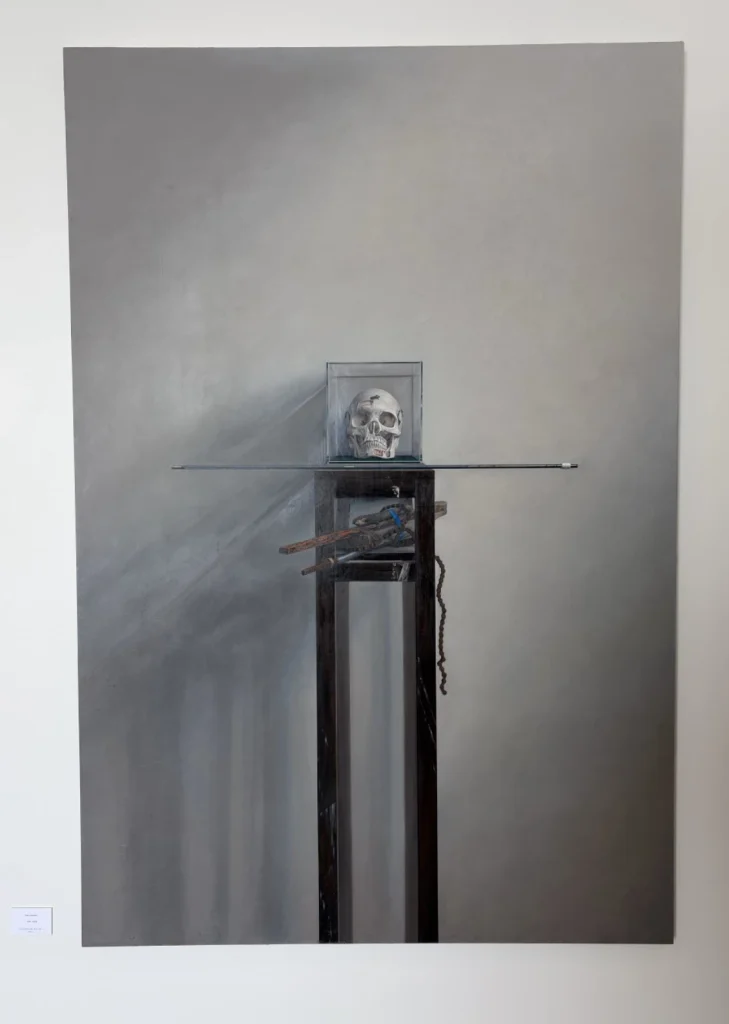
In Pale chamber, the motif appears at first to follow the conventions of traditional still life. A skull is enclosed in a glass case, aligned with a horizontal metal rod and placed upon a wooden stand. A bundle of long objects—threaded rods, metal pipes, pieces of wood, and a bicycle chain—rests on a shelf below. The composition is restrained and symmetrical, with generous empty space surrounding the central elements.
Yet the work resists being read as a mere depiction of objects. The painting renders not only the motifs but also the circulation of light, the subtle texture of the wall, and the density of the surrounding air. What is represented is less an arrangement of things than a specific situation: a place in which these things appear. The gray background is not uniform; faint variations in tone and surface suggest a wall that absorbs and reflects light unevenly. The atmosphere is cool but not hostile. Rather than standing before an image, the viewer is made to feel as though they have arrived at a site already in existence.
The conventional “distance of viewing” associated with still life is here recalibrated with particular care. The objects do not invite symbolic interpretation so much as they establish a condition of presence. They are positioned neither theatrically nor neutrally, but in a manner that foregrounds the act of looking itself.
Reflection and the Withheld Support

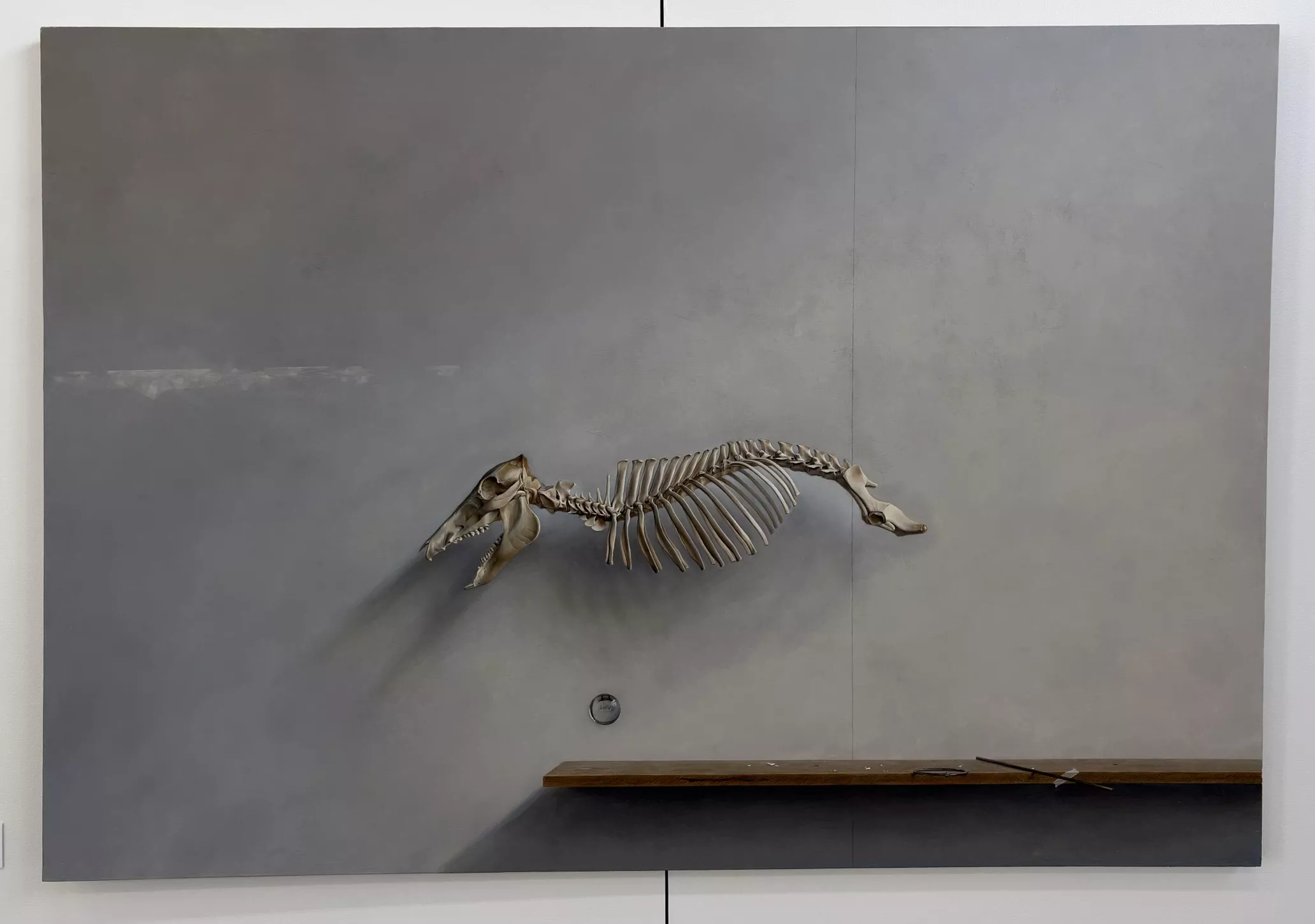
A similar logic operates in Still…. A skeleton model appears suspended in midair, its supporting structure largely erased. In one area of the painting, however, a small spherical reflective surface is depicted. Within this reflection, an inverted image of the scene emerges, including the stand that supports the skeleton—an element absent from the main view. Support is simultaneously removed and preserved: denied as structure, yet retained as reflection.
This spherical reflection reveals an important aspect of Takahashi’s realism. The act of faithful depiction does not simply show what is visible; it also points toward what is withheld. The difference between what is painted and what is omitted becomes perceptible. Realism, in this sense, does not resolve into transparency but instead exposes the conditions of seeing itself.
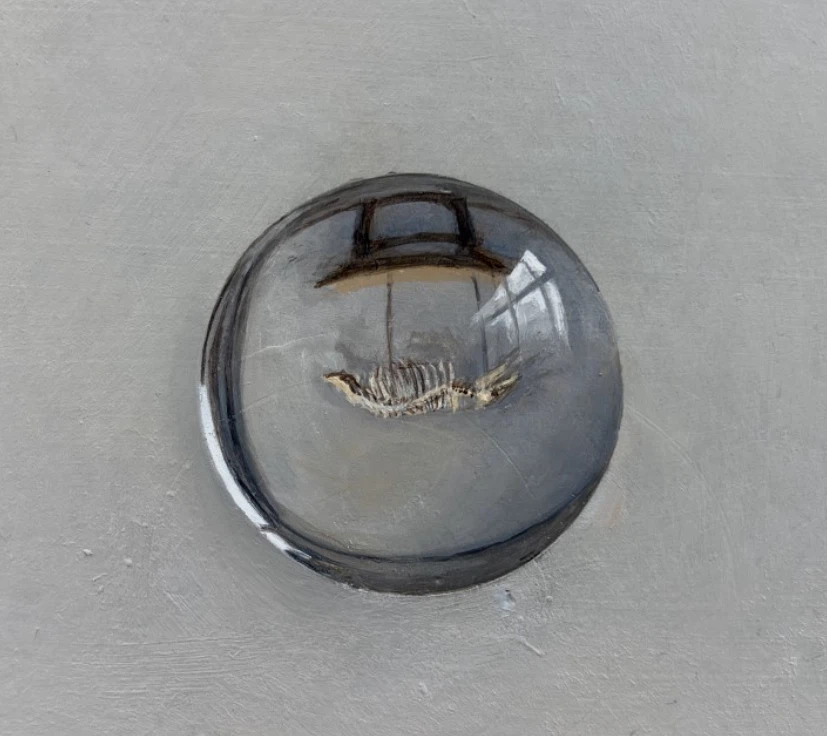
The reflective sphere functions as a device that folds the image back onto itself. It discloses the invisible framework of the composition while maintaining the illusion of weightlessness in the main body of the painting. The viewer becomes aware not only of what is shown but of how it is supported, staged, and ultimately constrained.
Still Life as a Scene of Viewing
The defining feature of Takahashi’s still lifes lies less in the symbolic meaning of bones or skulls than in the construction of space. Such motifs might easily invite allegorical interpretation, yet Takahashi’s paintings resist this tendency. Meaning is not asserted in advance. Objects are placed with their own weight and presence, neither dramatized nor neutralized. The paintings maintain a steady tension between proximity and distance, familiarity and detachment.
Within this restrained framework, Takahashi’s work proposes a subtle rethinking of still life. Rather than presenting objects as isolated entities, the paintings establish a field in which light, surface, and reflection are inseparable from the things depicted. What is ultimately formed is not an image of objects but an image of viewing itself—a scene in which the act of seeing becomes part of the subject.