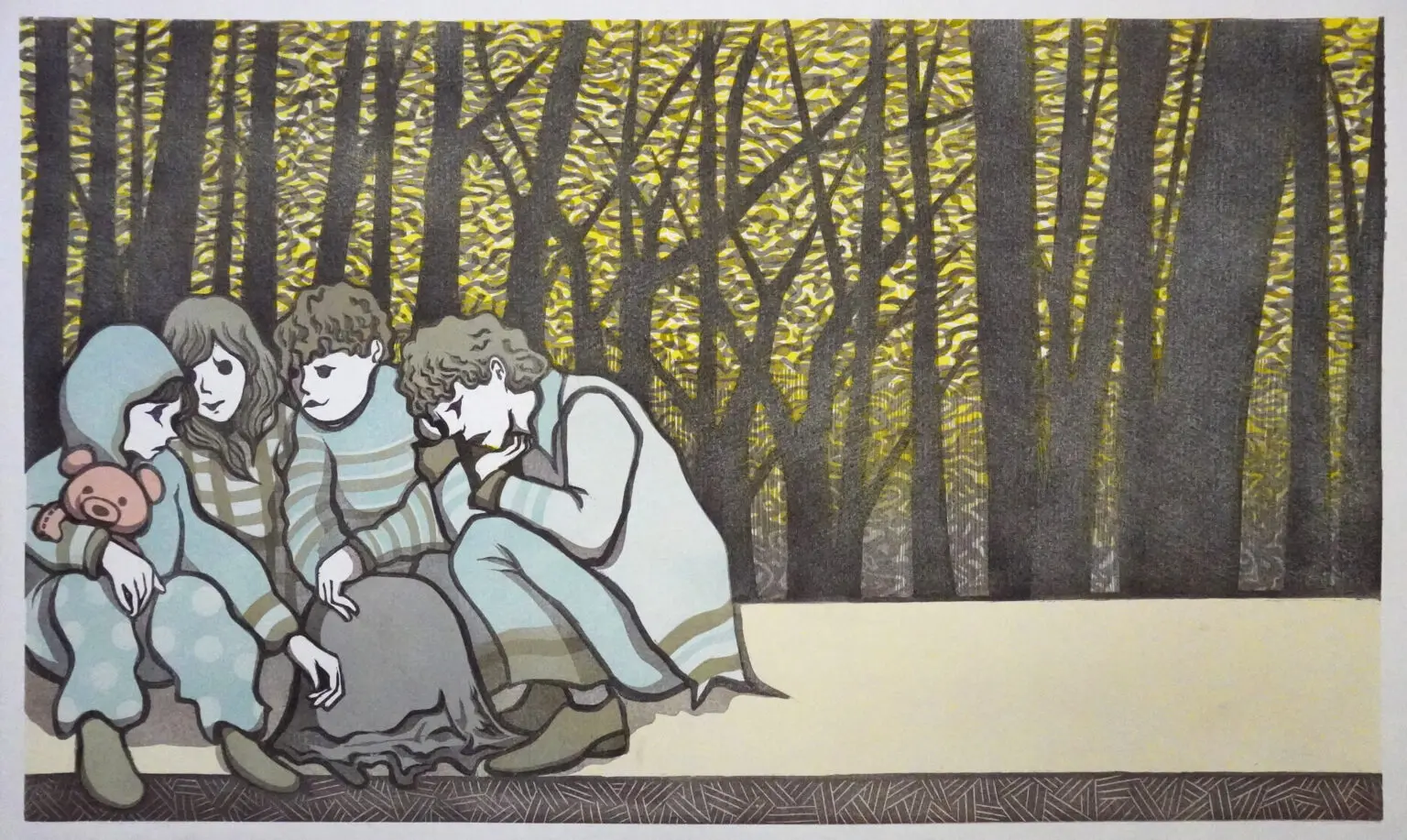
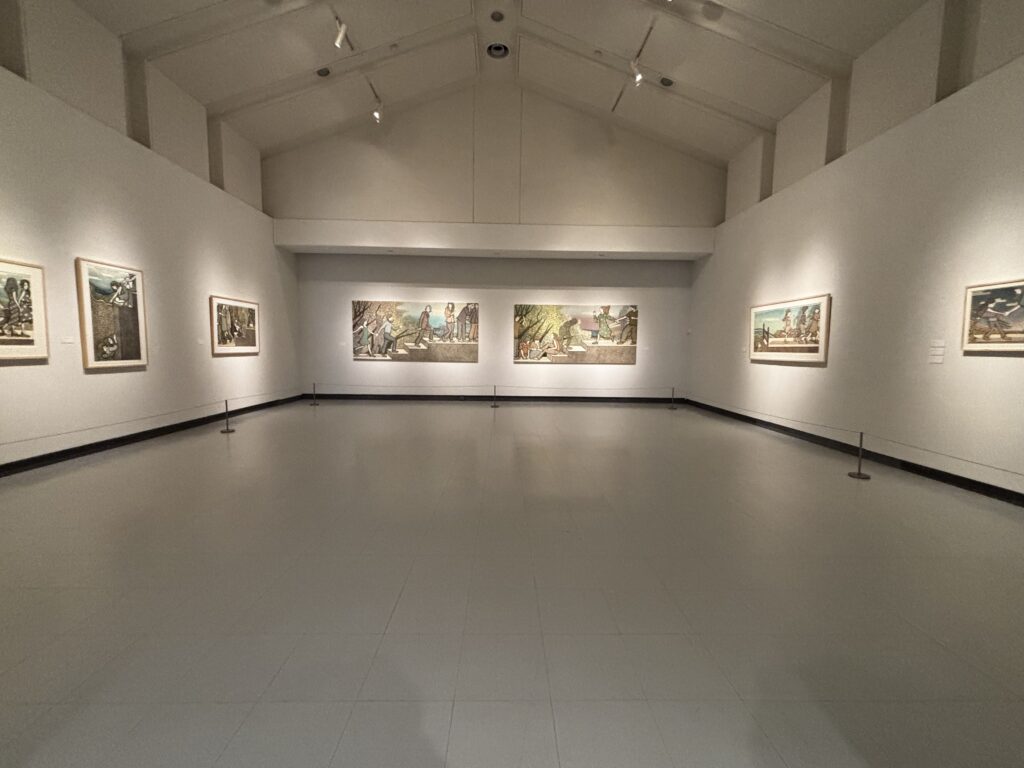
In November 2025, Sapporo Art Park Museum opened relief, a solo exhibition by Michimata Aoi. For an artist who had completed her MFA at Musashino Art University earlier that same year, a museum solo exhibition was an uncommon beginning. Yet what the exhibition presented was not the ambition of a young artist in a hurry. It was something quieter—and more unsettling.
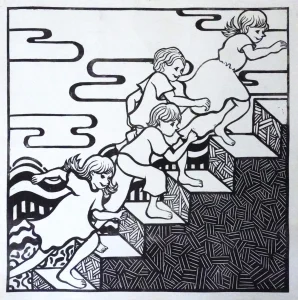
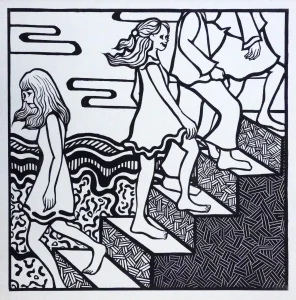
In Michimata’s woodblock prints, people sit on staircases. Some are climbing. Some have stopped. A few glance back toward where they came from, though the steps behind them seem to have shifted in shape. As the exhibition text for relief noted, the figures wear clothing without era—no logos, no uniforms, nothing that anchors them to a specific decade. They could be anyone. This openness is not vagueness; it is an invitation.
Michimata works in oil-based woodblock printing using a technique known as reduction printing. The block is carved progressively while layers of color are printed onto washi paper, each stage permanently altering the block before the next impression is pulled. Once a layer is printed, the block can never return to its previous state. If a print is damaged during the process, the edition simply decreases. There is no way to recreate what has already been lost. A reproductive medium that cannot reproduce—each edition becomes, in effect, a singular existence.
This irreversibility is not incidental to her subject matter. It is the subject matter.
The staircase in Michimata’s work derives from a concept known as “Kafka’s Staircase,” proposed by the Japanese social activist and writer Ikuta Takeshi. In Letter to His Father, Franz Kafka described the pain of being unable to do what others take for granted, likening it to standing on the same step as everyone else yet experiencing its height differently. Ikuta extended this metaphor to homelessness and social exclusion: descending the staircase—losing one’s job, losing one’s address, slipping into life on the street—happens step by step, often without conscious awareness. But climbing back up is another matter entirely. Each step that once seemed ordinary now rises like a wall.
Michimata encountered this concept during her third year at university, at a time when she herself was uncertain about her direction. She began making work about staircases not as illustrations of a social theory, but as a way of thinking through her own position. Her first series, presented as her graduation work in 2023, consisted of nine woodblock prints: people ascending, descending, pausing. The staircase appeared as a structure built by society, alongside the quiet question of whether everyone is truly required to climb it.
What has developed since then is not simply a continuation of this inquiry, but a deepening of it.
In her more recent work, Michimata shifts from the difficulty of climbing to something harder to define: the experience of finding yourself on a particular step and remaining there. You are on the same step as others. There is comfort in this—the relief of not being alone, of sharing a position. But the comfort does not settle. It carries inside it a low, persistent question: is this rest, or is this where I stop? Am I here by choice, or because I could go no further?
The title of her exhibition at aaploit, community of, names this ambivalence directly. Community as shelter, community as stagnation. The warmth of shared circumstance, and the unease that the circumstance itself may never change. Michimata does not resolve this tension. She holds it open. The figures in her prints neither suffer visibly nor appear at ease. They simply remain—and it is in this remaining that the work gathers its weight.
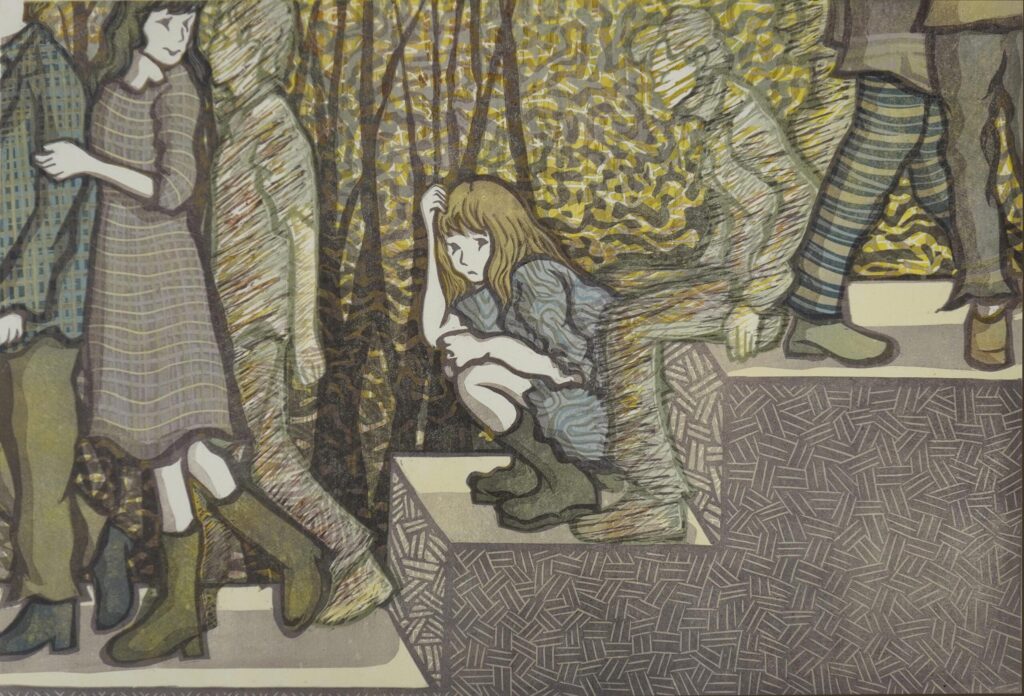
Michimata prints from MDF board—compressed wood fiber without natural grain—rather than from solid woodblocks. This is a deliberate choice. By eliminating the wood grain that would normally transfer to the printed surface, she frees the image from that familiar texture. She mixes small amounts of pigment into transparent printmaking medium, building color through dozens of translucent layers. The accumulated impressions create a subtle luminosity reminiscent of mica printing, where colors seem to advance and recede at once. You have to stand in front of the work. The depth is quiet, and it takes a moment to arrive.
Her visual language is intentionally gentle: soft forms, muted expressions, narrative situations left unresolved. The figures do not dramatize their circumstances. They exist within the frame, and through that stillness, viewers begin to project their own narratives—placing themselves on whatever staircase they happen to be navigating.
This combination of serious social content and a tender visual register is unusual. It avoids both the didacticism of social-realist printmaking and the detached irony common in much contemporary practice. Instead, it trusts the viewer to find their own way in.
Since her graduation exhibition in 2023, Michimata’s trajectory has been swift. Her work was discussed in Gendai Shiso (Contemporary Thought), one of Japan’s leading intellectual journals, in an essay by Ikuta Takeshi himself—the originator of the concept reflecting on its transformation into visual form. Her prints were acquired by Arts Maebashi, a public museum in Gunma Prefecture. In February 2025, she presented community of at aaploit, followed by participation in Art Fair Tokyo the next month. That summer, her work appeared in a group exhibition at Arts Maebashi, where she also conducted a printmaking workshop. In November, she opened her first museum solo exhibition, relief, at Sapporo Art Park Museum, and her work was shown at INAS (Incheon Art Show) in South Korea.
Born in Chitose, Hokkaido in 2000, Michimata moved to Tokyo for university. The distance between hometown and capital is itself a kind of staircase—a sequence of decisions, each one reshaping what remains possible.
The question her work raises is not exclusively Japanese, though it emerges from Japan’s social conditions. In Japan, the academic and professional year begins in April. Graduation, job entry, and new terms converge in a single month, as if an entire generation were stepping onto the same staircase at once, expected to climb at the same pace. Those who fall behind, pause, or step aside tend to vanish from view within this structure. Ikuta’s concept names what usually remains unnamed: the fine gradations between inclusion and exclusion, and the way a single missed step can quietly become permanent.
What gives Michimata’s work resonance beyond this context is its refusal to moralize. She does not argue that the staircase should be dismantled, nor that everyone must climb it, nor that remaining still is virtuous. She presents the staircase as a condition, and the people upon it simply as people—each with their own weight, their own view from where they stand.
The block, carved and re-carved, retains the memory of every previous state while revealing only its present one. Like the figures on the stairs, it cannot return. It can only move forward, carrying within it everything that has already occurred.
The artist statement and CV are available here.