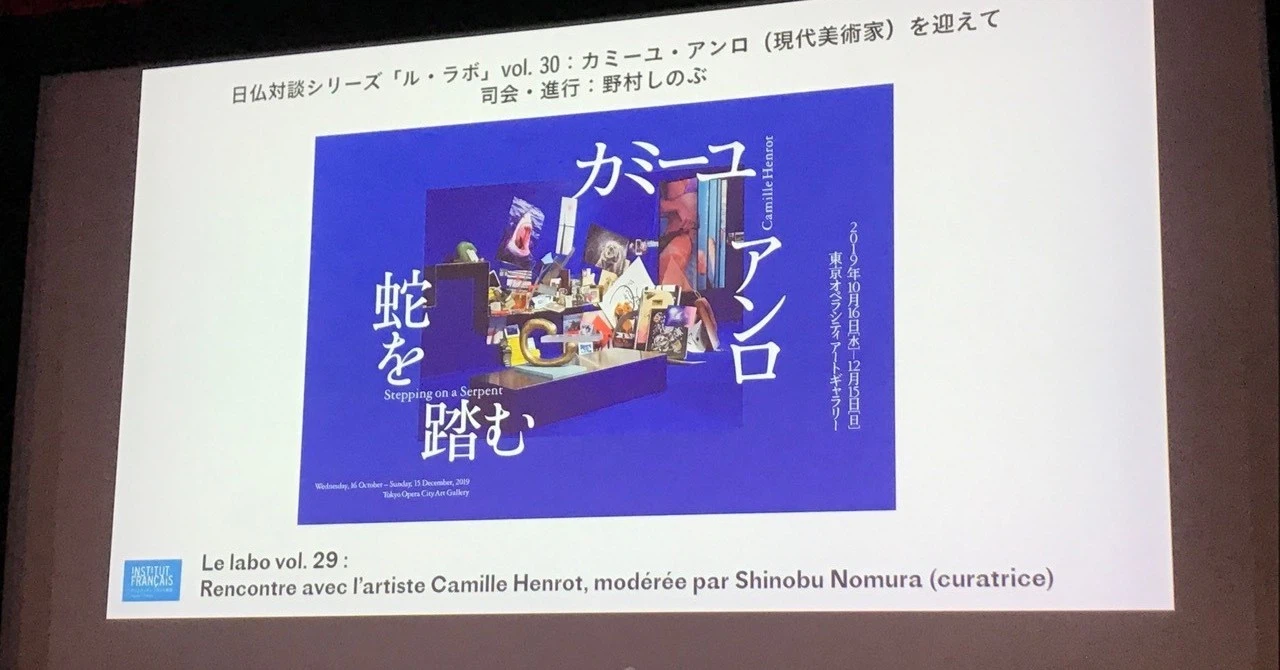
This essay examines Camille Henrot’s exhibition Snake Stepping (2019) at Tokyo Opera City Art Gallery as a site where cultural transmission occurs through the very failure of translation. By situating Henrot’s collaboration with the Sogetsu School of Ikebana alongside the practices of Pierre Huyghe and Ho Tzu Nyen, the text explores how the “untranslatable” becomes a generative condition in contemporary art. Rather than seeking a seamless synthesis of cultures, Henrot’s work interrogates the limits of our understanding, revealing the fragile yet persistent space where communication persists amidst irreducible difference.
Introduction
Camille Henrot’s exhibition Snake Stepping (2019), held at the Tokyo Opera City Art Gallery, marked a decisive moment for understanding her practice. The title is borrowed from a short story by the Japanese writer Hiromi Kawakami, in which the boundary between the narrator’s inner life and the surrounding world gradually dissolves. What appears at first as a strange external event turns out to be inseparable from the subject’s own psychic landscape.
This reference is not incidental. It foregrounds a recurring problem in Henrot’s work: the instability of distinctions—between self and other, nature and culture, knowledge and misunderstanding.
Among the works presented, particular attention should be paid to the ikebana series Is it possible to be a revolutionary and love flowers? Initiated in 2011 as a self-taught practice, the series was, for the first time, fully realized with the cooperation of the Sogetsu School of Ikebana for this exhibition, in collaboration with master practitioners Katei Motoe and Kazuko Nakata. This could be described as a form of authentication by an established school of ikebana, though Sogetsu itself has historically shown little concern for rigid distinctions between orthodoxy and deviation. It is often the surrounding discourse—rather than the school—that insists on such hierarchies. This structure already contains a question about cultural transmission and legitimacy.
Transmission Through Untranslatability
Henrot’s work is frequently discussed in terms of “information overload” or as a reflection on archives of knowledge. Grosse Fatigue (2013), awarded the Silver Lion at the Venice Biennale, draws on the Smithsonian Institution’s vast collections to address humanity’s obsession with collecting and classifying the world. This reading is valid, but incomplete.
At a deeper level, Henrot’s practice stages a paradox: the coexistence of mutual incomprehension and undeniable transmission.
In Grosse Fatigue, creation myths from different regions—Africa, Melanesia, Asia, and the Western world—are juxtaposed. These myths are fundamentally untranslatable into one another. And yet, striking structural similarities emerge. The cosmogony described in the Kojiki (Japan’s oldest mythological chronicle) resonates with narratives from Melanesia. How do such parallels arise between cultures without historical contact?
The work does not resolve this question. Instead, it presents the cognitive dissonance itself: something is shared, even when translation fails.
“Cultivated Nature” and the Avant-Garde Impulse
To understand Henrot’s ikebana series, it is necessary to consider the specific position of “nature” within Japanese culture.
In The Chrysanthemum and the Sword (1946), Ruth Benedict famously described Japanese culture through the dual image of the sword and the chrysanthemum: devotion to martial discipline on one hand, and meticulous aesthetic cultivation on the other. She concluded by remarking that the chrysanthemum is beautiful even in its natural state.
Yet the chrysanthemum is also the imperial emblem. Whether Benedict fully grasped this implication remains unclear. What is certain, however, is the persistence of a cultural impulse to intervene in what is already beautiful—to refine nature rather than merely admire it.
Bonsai, ornamental carp (nishikigoi), and garden design are all practices of “cultivated nature.” Today, these forms circulate globally, attracting collectors not only from Europe and North America, but also from South America and Australia. What resonates is not nature as untouched wilderness, but nature transformed through human intervention.
Sofū Teshigahara, founder of the Sogetsu School, famously stated: “Once flowers are arranged, they cease to be flowers; they become human.”
This statement resonates uncannily with Henrot’s question—Is it possible to be a revolutionary and love flowers?—as if offering its most concise reply. It is also crucial to recall that Sogetsu itself emerged as an avant-garde movement within ikebana, defined by its rejection of fixed forms and rigid conventions. Under Teshigahara’s leadership, it aligned itself with postwar experimental art practices and actively engaged with international avant-garde networks.
From this perspective, Henrot’s apparent deviation does not stand in opposition to tradition. Rather, it aligns with one of tradition’s most radical internal impulses: the breaking of form in order to rediscover what form can do.
Ikebana is not decoration. It is a practice of metamorphosis. Through human action, plants alter their mode of existence. Henrot’s attraction to ikebana may lie precisely here: in the visible negotiation between nature and culture, between what is given and what is transformed.
Creation Through Translation
In the series Is it possible to be a revolutionary and love flowers?, each arrangement derives from a specific book. The title itself is borrowed from Marcel Liebman’s biography of Lenin, and the chosen texts span literature, philosophy, and anthropology. These texts are “translated” into floral compositions.
The pairing of books and flowers is deliberate. Formal analogies, wordplay between titles and plant names (both vernacular and scientific), botanical characteristics, and cultural symbolism are all mobilized. Rigor and play coexist.
Henrot has spoken about her sensitivity to translation. In interviews, she has described reading French literature in the original and then encountering its English translations, noticing how nuance shifts, how something is inevitably lost. This is an embodied knowledge: what it means for one’s own language to be displaced.
Pierre Huyghe similarly addressed this experience when he began working in New York, foregrounding what disappears when French is rendered into English. Rather than erasing linguistic discomfort, he incorporated it into the conditions of his work.
In contrast, Japanese culture often invokes the principle “When in Rome, do as the Romans do.” Discomfort in a foreign context tends to be absorbed through adaptation, or displaced onto another axis. Henrot and Huyghe do the opposite: they retain the discomfort. It becomes the generative site of the work.
The title Snake Stepping makes this logic explicit. In Kawakami’s story, the protagonist initially misrecognizes what she encounters as something external and uncanny, only to realize that the disturbance belongs as much to herself as to the world. What seems like an encounter with radical otherness is revealed as a fracture within perception itself.
Here, loss of certainty is not an obstacle to meaning but its condition. Translation does not merely transfer content; it exposes the instability of boundaries.
This may explain why scholars of Japanese culture from outside Japan have been drawn to Henrot’s practice. Her work functions as an apparatus that interrogates what “legitimate understanding” might mean.
Comparative Perspective: Huyghe and Ho Tzu Nyen
This structure is not unique to Henrot.
Pierre Huyghe’s Human Mask (2014) depicts a monkey wearing a human mask wandering through an abandoned restaurant in the Fukushima exclusion zone. For Japanese viewers, the setting invokes specific cultural codes: the izakaya, traditions of trained monkeys, and the trauma of Fukushima. For Western audiences, these codes may not be legible, and the work has sometimes been received primarily through the lens of animal ethics.
Huyghe embeds this gap in interpretation within the work itself. Untranslatability is not a problem to be solved but a condition to be staged.
Similarly, Ho Tzu Nyen’s Voice of Void (2021) engages with the Kyoto School philosophers through archival materials collected and translated by the Japanese scholar. A Singaporean artist working from translated sources to address Japanese wartime thought foregrounds a structural question: what does it mean for a non-participant to narrate another’s history?
In all three cases, the impossibility of accessing an “original” becomes a premise rather than a limitation. Complete understanding is unattainable, yet something continues to circulate.
The Meaning of Lightness
If ikebana can be understood as an act of intervening in the body of another—reshaping vegetal life through cultural form—Henrot’s drawing series Identity Crisis shifts this operation inward. Here, the site of transformation is no longer the plant, but the self: clothing as the interface through which identity is continuously negotiated and recomposed.
While works such as Grosse Fatigue and The Pale Fox engage with informational excess, the drawings appear almost improvisational. Executed in watercolor and ink, they often depict garments—intimate, everyday forms.
The title Don’t Fit signals a shift of subject: not “it doesn’t fit me,” but “I don’t fit.” Identity is not an essence but a construct shaped through social relations, and it is plural. Henrot addresses this not with solemnity but with play.
Although not shown in the Tokyo exhibition, her practice also includes erotic and vandalistic drawings. This oscillation between gravity and levity prevents her criticality from hardening into purely intellectual operation. One does not need to frown in order to think.
Conclusion: Shared Limits of Understanding
Henrot’s work presupposes the failure of translation. Complete comprehension is impossible. Cultures are not fully translatable. When language becomes form, something is always lost.
Yet something is also transmitted.
What still transmits is not a message, but a boundary: the boundary of the viewer’s own knowledge. Standing before Henrot’s works, one is confronted with the question of what one knows—and what one does not.
The collaboration with the Sogetsu School makes this visible. A self-taught artist encounters an established avant-garde tradition. What emerges is neither simple orthodoxy nor deviation, but something that appears only in the act of translation between them.
In an era saturated with information, we are accustomed to the illusion of understanding. Search engines produce answers. Translation software converts languages. But do we truly understand?
Henrot’s practice resists this ease. It insists on the irreducibility of difference while continuing to attempt communication. In doing so, it returns us to our own limits—and to the fragile space where something nevertheless passes between them.
Exhibition Information
Camille Henrot: Snake Stepping
Tokyo Opera City Art Gallery
October 16 – December 15, 2019
Ikebana Production Cooperation
Katei Motoe, Kazuko Nakata (Sogetsu School of Ikebana)
Literary Reference
The exhibition title Snake Stepping is inspired by a short story of the same name by Hiromi Kawakami.